Glove Education Center

Four choices settle almost every glove order — material, thickness, texture and fit. This page works through all four, plus the two questions that come after them, and every section ends in the catalogue rather than in more reading.

Material

Nitrile or vinyl

This is the first fork and it decides most of the rest. Both are latex free, so neither carries a latex allergy risk. What separates them is how much abuse the film takes and what that costs per box.

Nitrile

The stronger film

A synthetic rubber that resists punctures, tears and a broad range of oils and solvents. It softens to the hand as it warms, so it fits closer the longer it is worn. This is the default for clinical, automotive, laboratory and industrial work.

  • Sharp edges, tools or components
  • Oils, greases and solvents
  • Long wear between changes
  • Exam and clinical settings

Overkill for short tasks where gloves change every few minutes.

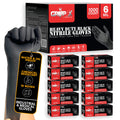
Start hereBlack Nitrile Exam Gloves4 mil · S–XXL · powder free
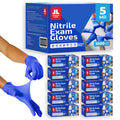
See every nitrile line

Vinyl

The economical film

A PVC film that costs less per box and goes on and off quickly. It suits short, low-stress, high-turnover tasks — the kind where a glove is changed between every job rather than worn through a shift.

  • Food prep and service
  • Light cleaning and housekeeping
  • Salon and front-of-house work
  • High glove turnover, tight budget

Not the choice for solvent handling or anything with a puncture risk.

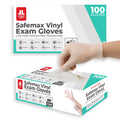
Start hereSynthetic Clear Vinyl GlovesS–XL · powder free

See every vinyl line

Scroll sideways for the full comparison

Nitrile and vinyl disposable gloves compared
 NitrileVinyl
Best forMedical, automotive, industrial, laboratoryFood prep, service, light cleaning
DurabilityHigher puncture and tear resistanceSuited to short, low-stress tasks
Chemical resistanceBroader resistance to oils and solventsLimited — not for solvent handling
FitConforms to the hand as it warmsLooser, easier on and off
Thicknesses stocked4, 5, 6 and 8 milSingle standard weight
Cost per boxHigherLower
LatexLatex freeLatex free

Thickness

How thick, and why

Thickness is measured in mils — one mil is a thousandth of an inch of material at the palm. It is the single number that most changes how a glove feels and how long it survives a shift. Thicker is not better; it is a trade of fingertip feel for durability, and the right end of that trade depends entirely on the job.

  1. 4 mil

    Light duty

    The thinnest wall we stock, and the most sensitive. Made for high-turnover work where gloves are changed constantly and dexterity matters more than endurance — food handling, light assembly, general front-of-house.

    Browse 4 mil
  2. 5 mil

    The everyday exam weight

    The general-purpose middle of the range and the usual choice for clinical and dental work. Enough wall to last a procedure without dulling the touch that the work depends on.

    Browse 5 mil
  3. 6 mil

    Heavy duty

    Where the glove starts working as protection rather than as a barrier. Suits longer wear, rougher handling and jobs with real puncture risk — workshop, janitorial and general industrial.

    Browse 6 mil
  4. 8 mil

    Maximum

    The thickest wall in the range, and the only one that carries the raised diamond texture. Built for mechanics, chemical handling and heavy assembly — the jobs that destroy a thinner glove within the hour.

    Browse 8 mil

Texture

Grip, wet or dry

Texture is only about one thing: holding on when the surface is wet, oily or smooth. It is a ladder, and each rung costs a little of the flat, quiet contact that fine work wants.

  1. Smooth

    Maximum sensitivity

    An untextured surface, for work where the sense of touch is doing the job and nothing is slippery. Least grip, most feel.

  2. Textured fingertips

    The default

    A fine pattern on the fingertips only, so grip improves exactly where you hold things and the palm stays smooth. This covers the overwhelming majority of handling, clinical and food work, and it is what most of the catalogue carries.

  3. Raised diamond

    Wet and oily grip

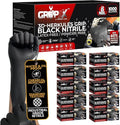
    A three-dimensional pattern across the whole gripping surface. The raised ridges channel liquid away from the contact points instead of letting it sit under the hand, which is what heavy automotive and industrial work needs. In our range this is the GRIPXX 8 mil line. See how it is built.

Sizing & fit

Getting the size right

Fit is the decision people guess at, and it is the one that wastes the most gloves. Too big and the fingertips catch and tear; too small and the hand tires within the hour and the cuff rolls.

Measure, don’t guess

  1. Lay your hand flat, palm up, fingers together and thumb tucked in.
  2. Measure straight across the widest part of the palm, just below the knuckles. Leave the thumb out of it.
  3. Check that figure against the size chart on the product page for the line you are buying — the chart is published there next to the price.

Sizes are not interchangeable between materials. A vinyl medium and a nitrile medium do not behave the same way on the hand, because nitrile relaxes as it warms and vinyl does not.

What the range covers

  • X-Small
  • Small
  • Medium
  • Large
  • X-Large
  • XX-Large

Most lines run Small through XX-Large. X-Small is carried on the Synsafe and 5 mil nitrile lines; check the size selector on the product page before ordering for a team that needs it.

  • Order a mixed team from one line. Fit behaves consistently across sizes within a line and does not between them.
  • Buy a box before a pallet. One 100-count box across the team settles the size split before the standing order is set.
  • Size up for long wear, not for comfort. A glove worn for hours needs room; a glove worn for minutes needs grip.

Sterile or not

Sterile or non-sterile

A short section, because for most buyers it is a short question. The requirement comes from your procedure, not from the glove.

Non-sterile

Almost everything

Manufactured clean but not processed to a sterility assurance level, and packed by the box or the case. This covers examination, handling, food prep, cleaning, laboratory and every industrial task — the overwhelming majority of glove use, and everything in this catalogue.

Browse the catalogue

Sterile

Procedure-specific

Individually packed in matched pairs and processed to a validated sterility level, for procedures that require a sterile field. Ordered per procedure rather than by the case, and priced accordingly. If your protocol calls for sterile, no non-sterile glove substitutes for it.

Ask us about sterile lines

Not sure which your work requires? It is set by your own procedure or protocol, not by the product. Check that first — and if you want a specification read against it, send it to us.

By the job

Which glove for which job

The four decisions above, already made for the eight kinds of work we supply most. Treat it as a starting point rather than a rule — your own protocol wins where the two disagree.

Scroll sideways for the full table

Recommended material and thickness by kind of work
The workMaterialThicknessWhyStart here
Medical & dentalNitrile5–6 milBarrier integrity through a procedure, with the touch intact5 mil nitrile
AutomotiveNitrile6–8 milOils, sharp edges and long wear between changes8 mil nitrile
Food serviceVinylStandardConstant changes; cost per glove matters more than wear lifeVinyl lines
Industrial & assemblyNitrile6–8 milPuncture risk and full-shift wear6 mil nitrile
Cleaning & janitorialNitrile4–6 milChemical contact, with cost held down on high turnover4 mil nitrile
Beauty & salonVinyl or nitrile4 milDexterity first; nitrile where colour or solvent is involved4 mil lines
LaboratoryNitrile4–6 milBroad chemical resistance with fine handling retainedNitrile lines
VeterinaryNitrile5–6 milTear resistance under movement, longer cuff where available6 mil nitrile

Working in something not listed? See the industry pages, or answer four questions and be shown the result — use the glove finder.

Questions

Questions people ask

Materials and specifications

What does “mil” mean?

A mil is one thousandth of an inch, measured at the palm, and it describes the thickness of the glove wall. It is the single number that most changes how a glove feels and how long it survives a shift.

Does a thicker glove always mean a better glove?

No. Thickness trades fingertip sensitivity for durability. For work that changes gloves constantly, a lighter glove is the better tool and the cheaper one. Thickness earns its cost where there are sharp edges, oils or long wear.

What is powder free, and why does it matter?

Powder was historically used to make gloves easier to don. Powder free avoids leaving residue on surfaces, food or work, which is why it is the standard across food, medical and industrial settings. Every London Labs glove is powder free.

Are any of your gloves made of latex?

No. Every line in the catalogue is latex free — nitrile or vinyl — so none of them carry a natural rubber latex allergy risk.

What is the difference between an exam glove and a general purpose glove?

It is a grade, not a shape. Exam-grade gloves are made and tested to the standard for medical examination use; general purpose gloves are not held to it and are intended for non-medical handling. The two can look identical, so buy on the grade rather than on the look.

Which gloves handle solvents and oils?

Nitrile, and the thicker the better for sustained contact. Vinyl is not the material for solvent handling. Chemical resistance varies by the specific substance and by contact time, so if you are working to a defined chemical list, send it to us and we will read it against the specifications rather than guess in a table.

Fit and sizing

How do I work out my size?

Measure straight across the widest part of your palm, just below the knuckles, with the thumb tucked out of the way. Check that figure against the size chart on the product page for the line you are buying, rather than against the size you usually wear in a different material.

How do I size a mixed team?

Order the whole team from one line, so the fit behaves the same way in every size, and run a single 100-count box across the team first to settle the split before you commit to a standing order. Most lines run Small through XX-Large.

Is a medium the same across materials?

Not in practice. Nitrile relaxes and conforms as it warms; vinyl stays where it is cut. Someone comfortable in a vinyl medium may want a different size in nitrile, which is another reason to buy a box before a pallet.

Do you stock X-Small or XX-Large?

Both, but not on every line. X-Small is carried on the Synsafe and 5 mil nitrile lines, and XX-Large across most of the nitrile range. The size selector on each product page is the authority — it only shows what that line actually runs.

Use and compliance

Do I need sterile gloves?

Only if your procedure specifies a sterile field. The requirement comes from your own protocol, not from the product, so check that first. Everything in this catalogue is non-sterile, which covers examination, handling, food, cleaning, laboratory and industrial work.

Can the same glove be used for food and for medical work?

Some lines are certified for both and are labelled as such on the product page; others are not. Read the certifications listed on the line you are buying rather than assuming, because the two uses are governed separately.

Can disposable gloves be reused or washed?

No. They are single use by design. Washing degrades the film and compromises the barrier without any visible sign that it has happened, so a washed glove is a glove you can no longer trust.

How should gloves be stored?

Cool, dry, out of direct sunlight, and in the original box until use. Heat and UV both age the film. Stock rotates on the date printed on the case, so shelve new deliveries behind what is already open.

Where do I find the certifications for a specific line?

On the product page, in the specification panel next to the price rather than behind a request form. If you need documentation for an audit, ask us and we will send it.

Buying

How much should I buy at once?

Boxes suit a van or a single bench. Businesses buying for their own operations usually land on the 1,000 count carton, and a pallet where usage is steady. See bulk purchasing.

Can I get a sample before committing to a case?

Yes — that is what the 100-count box is for, and it is the cheapest way to settle both the size split and whether the line feels right in the hand. For larger evaluations, talk to us.

Do you price differently for businesses?

Yes. Volume pricing, purchase orders and standing orders are handled through the bulk side of the business. Request bulk pricing.

Still not sure which glove to order?

Answer four questions and the finder will narrow the catalogue to the lines that match. Use the glove finder, or describe the job to us and we will tell you what we would send.

Further reading

The longer guides

Everything above is the short version. These go further, for the questions procurement asks before it signs anything.

Know what you need? Go and get it.

Or hand the decision to the finder — four questions and it narrows the catalogue for you.